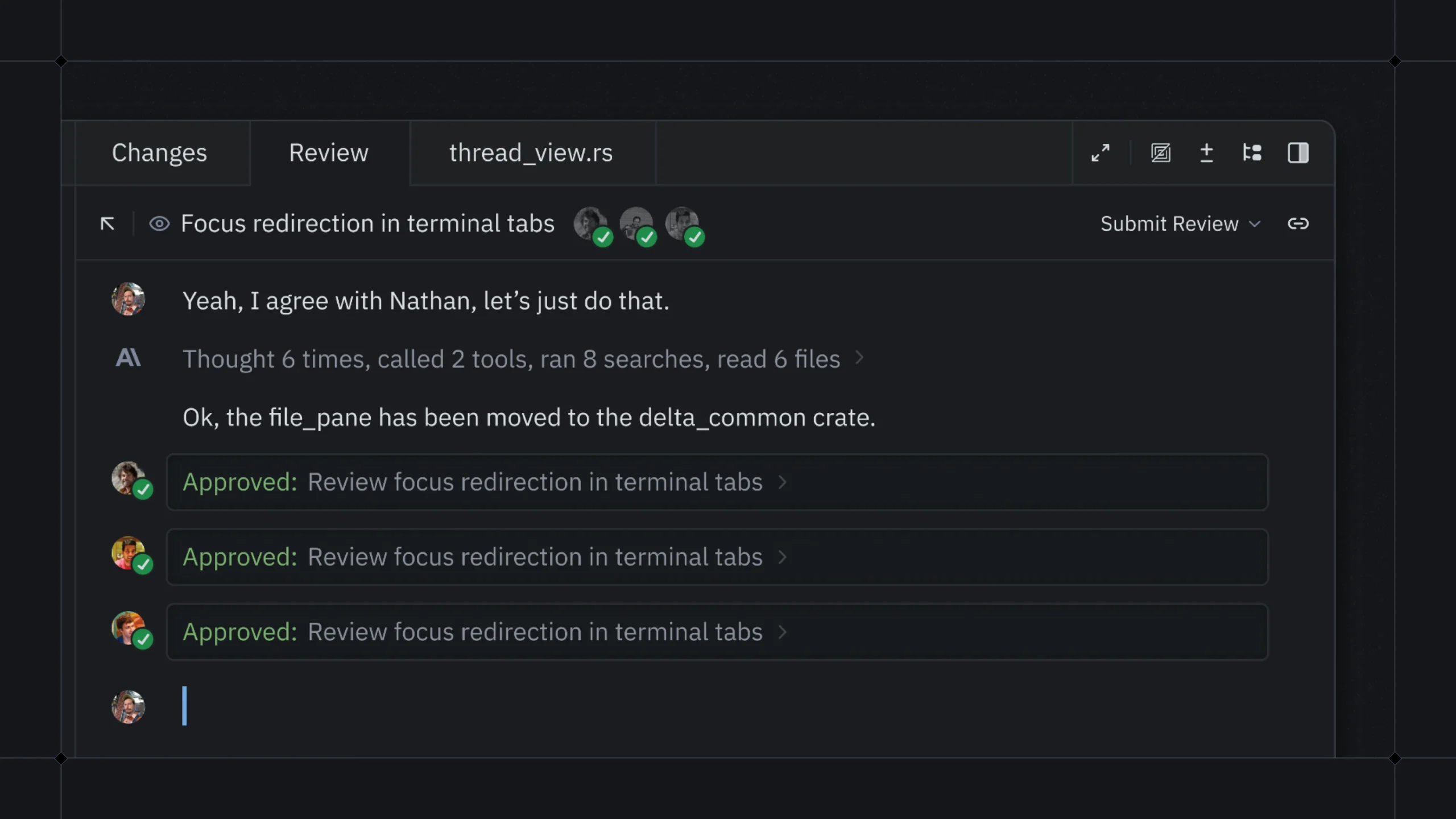
Zed opened Delta to the public on September 16, 2026. Delta keeps an agent conversation, the code it changes, and reviewer comments in one shared thread. Ignore the promise to replace pull requests for a moment. The practical benefit is being able to inspect why code changed without reconstructing that reasoning from a large final diff.
The public beta is available as a desktop app for macOS, Linux, and Windows, as well as on the web. Delta is free during the beta. Zed says paid individual and team plans will come later and that a free version will remain available.
What Delta records beyond Git
Git records repository snapshots at commits. DeltaDB continuously records messages, comments, and file edits as deltas. Each delta has a stable identity, so a comment can remain attached to a change even when the surrounding code moves.
The unit of work is a thread. When you open the top-level folder of a Git repository, Delta creates a separate Delta worktree by default. Agent edits stay away from the original checkout until you decide to bring them back through the local remote, push a branch to origin, or copy files from the managed checkout. The existing repository, commits, branches, and remotes still work normally.
A reviewer can create a review subthread with the parent conversation and an isolated copy of its worktrees. That reviewer can ask the original agent about a design choice, test a different change, or fix a problem without disrupting the parent thread. The result can then be incorporated into the original work.
Install Delta and run a first task
Delta requires a Zed account and acceptance of the Delta Early Access Agreement. Supported systems are macOS 13 or later on Apple Silicon, glibc-based Linux on x86_64 or aarch64, and Windows on x86_64 or aarch64. Intel Macs are not listed as supported.
On Linux, download the archive for your architecture from the official download page and run:
export PATH="$HOME/.local/bin:$PATH"
tar -xzf delta-linux-<architecture>.tar.gz
./Delta/install.sh
delta
After signing in, connect a hosted model, an existing ChatGPT, GitHub Copilot, or Grok subscription, or an API key for Anthropic, OpenAI, OpenRouter, or OpenCode. API keys can be entered in settings or stored in ~/.config/delta/.env. Do not put them in the repository.
Start with a small task. Add the repository’s top-level folder, select Isolated Workspace, and give the agent a clear success check. When it finishes, open the Changes panel, inspect the before-and-after diff, and comment on a specific line if it needs revision or explanation. Move the resulting branch into your normal checkout or origin only after the check passes.
Pricing and model access
Delta shares plans and AI usage with Zed. The public beta itself is free. Zed Personal costs $0 and supports your own API keys or external subscriptions. Zed Pro costs $10 per month and includes $5 of hosted-model tokens each month. Usage beyond that credit is billed at the provider’s API list price plus 10%. The 14-day Pro trial includes $5 for GPT-5.6 Luna and does not require a credit card.
A ChatGPT Plus or Pro, GitHub Copilot, or eligible Grok or X subscription can also provide model access. That usage follows the provider’s limits rather than consuming Zed credits. Teams should decide which organization and provider owns the spend before several developers begin shared threads.
Security limits matter more than the beta label
Delta does not yet have an agent permission system or agent sandboxing. The agent can access the device where it runs and does not ask before each tool call, including potentially destructive ones. Isolated Workspace separates code changes from the original checkout, but it does not isolate the agent process.
Untrusted repositories need an inspection before they are opened. An executable .agents/prepare or .delta/prepare script can run when Delta first mounts a managed checkout. On macOS and Linux, .envrc can run through direnv when a terminal or agent command starts. AGENTS.md and skills under .agents/skills/ or .delta/skills/ become instructions for the agent.
Adding a repository uploads tracked files and untracked files that Git does not ignore to Delta’s servers as well as storing them locally. Delta uses Cloudflare R2, Durable Objects, KV, and D1 for server-side storage. Adding an already tracked secret to .gitignore later does not stop Delta from importing it. Personal threads are private by default, but sharing a thread grants access to its attached repositories and Delta worktree history, so check the sharing scope first.
Should it replace GitHub pull requests today?
Delta addresses a real review problem: large agent changes often arrive with too little explanation. Keeping the conversation, edits, line comments, and revisions together gives a reviewer more context than a final diff alone.
There are still important gaps. Repository-based access control, remote runtimes, and MCP support are in progress. Sandboxing and WSL support are on the roadmap. Teams that require approval gates, on-premises code storage, or a mature sandbox should wait. For an individual project or a trusted small team, keep the GitHub workflow and attach a Delta thread to the pull request while you compare the two.
Sources
- Zed: Replace PRs with Delta, now in public beta
- Install Delta
- Delta core concepts
- DeltaDB and Git
- Models and providers
- Data storage and deletion
- Agentic safety
Checked: September 17, 2026
Leave a Reply